|
|
The Main battle on Jan 8, 1815
View from the American parapet. Kaiser Aluminum Refinery in the background . Photograph by author .
Pakenham delayed his main assault until Jan 8, when he had brought up nearly 10,000 men, and planned to attack with about 5,500, keeping the rest in reserve.
Pakenham spent his last night sleeping at the Villere plantation. He awoke to go to where Thornton had just left at for the west bank at 3:00 a.m. with about 500 instead of the planned on 1,400 men because of problems with the boats, but could hear nothing. This force was to cross the river and seize Patterson's battery across the river and turn the guns against the American line.
The men on both sides knew an attack was planned on the 8th. Jackson, clearly felt that some sort of night attack was coming . Jackson, was awakened by a messenger who arrived from Morgan across the river, requesting more troops. Morgan and Patterson could see some activity by the British on the river and feared they were going to send a large force across the river to bypass Jackson and recross the river to take New Orleans .Jackson told the messenger to report back that he had no men to spare and that he was confident the main attack would be against his line. Jackson looked at his watch. It was 1:00 a.m. He then awoke his aides, telling them the enemy would be upon them in a few minutes . At 4:00 a.m. General Adair marched his marched his 1,000 Kentucky militia about 50 yards behind the American line as a reserve.
Jackson’s whole force on the New Orleans side of the river on the 7th was about five thousand in number, and of these only two thousand two hundred were at his line. Only eight hundred of the latter were regulars, and most of them were new recruits commanded by young officers. His army was formed in two divisions, the right commanded by Colonel Ross, acting as brigadier, and the left by Generals Carroll and Coffee, the former as major general and the latter as brigadier general. A mile and a half in the rear of his main line another entrenchment had been thrown up, behind which the weaker members of his army were stationed with pickaxes and spades. This line was prepared for a rallying-point in the event of disaster following the impending conflict. Jackson also established a third line at the lower edge of the city. General Morgan, on the opposite side of the river, prepared to defend his lines with only eight hundred men, all militia, and indifferently armed.
Click for larger image .
The British Plan of Attack
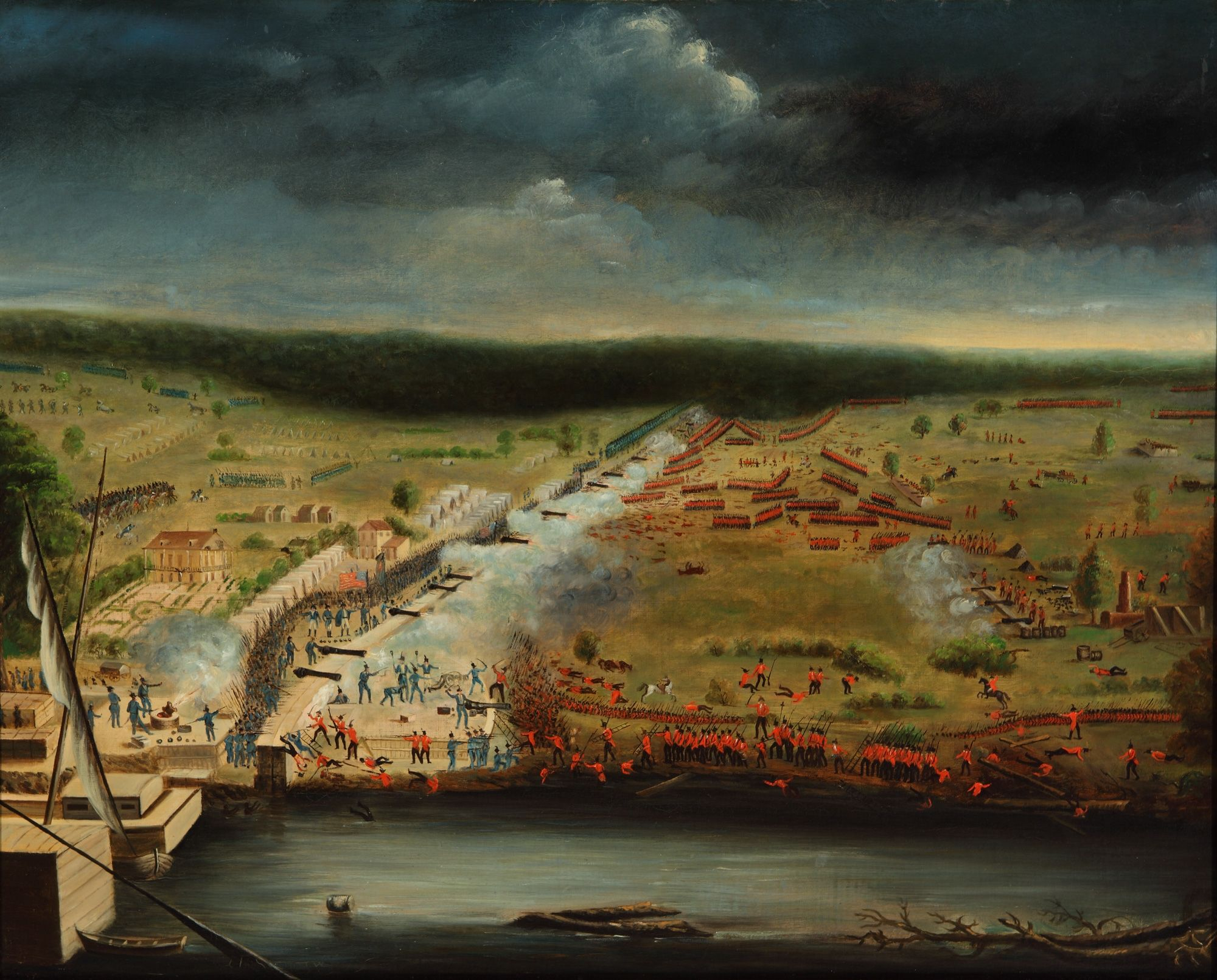
A 1815 painting of the battle by Jean-Hyacinthe Laclotte,one of Jackson's engineers, showing Jackson's headquarters behind the rampart on the left and the redoubt briefly taken by Colonel Rennie . Click for larger image .
Pakenham had hoped to take advantage of darkness to get his troops within a few yards of the American line, but confusion about the location of the ladders and fascines needed to cross the canal and scale the rampart caused a delay which cost him this advantage. If Pakenham had started the attack in darkness, the heavy fog would have provided excellent cover. I live about 4 miles up the river from where the battle took place, about a 100 yards from the river . When a heavy fog rolls in, it is difficult see more than 10 feet, and sounds become muffled and distorted.
Despite the problem with the fascines and Thorton's attack on the west bank, Pakenham decided to go ahead with the attack and not wait a day. At 4:00 a.m. he said, "I will wait my plans no longer", without checking to make sure Mullens was in place in front with his fascines and ladders . He was not. It was a critical mistake and seems strange for a professional like Pakenham. How did he expect his men to cross the canal and climb the parapet without the fascines and ladders ? Perhaps he felt it would sap the men's morale too much to wait and that the sight of the large force would send the Americans fleeing . But surely he realized at this point he was not dealing with the ill-prepared militia such as that defended Washington. Probably it would not have mattered. The West Indian corps that carried the fascines and ladders for Rennie's attack on the American left was ready, yet threw them down in the face of devastating American when they reached the American line .
The British troops were arranged in four columns to give the look of an imposing force. Reportedly, many of the troops were eager to get on with it, weary of the dismal conditions of the last two weeks and a chance to get at the loot and chance see to the beauties of New Orleans, reported to be most beautiful in America and were some of the first to wear make up. Many, however, had a sense of foreboding. Colonel Dale, commander of the 93rd highlanders, gave his watch and letter to the regiment's physician, telling him to give them to his wife, as he wouldn't return. This turned out to be true, he was killed 20 yards from the American rampart.
General Edward Pakenham ordered a complex attack against Jackson's position: a small force across the river on the west bank of the Mississippi under Colonel Thornton with the 85th Regiment was to seize Patterson's battery and turn it against the Americans . There was difficulty in getting boats and once underway, they were carried a thousand yards further than planned. Pakenham did not know the fate of Thornton's force, yet gave the signal for attack by sending off rockets. Many in the British army complained of this 'fatal rocket' as it did nothing but warn the American of the coming attack.
General Samuel Gibbs was to attack the American left and center with the 2nd brigade of the 4th,21st,44th and 93rd made up of 3,000 men. Gibbs was to skirt the cypress swamp and move rapidly toward the center and left held by Carroll's Tennessee militia . This was done after Pakenham noted the American parapet was lower on the American left closer to the swamp and information from a Spanish Creole deserter from the American lines named Galvez, who informed Pakenham the American left was held inexperienced militia that would probably flee if attacked. However, this was actually the strongest point of the American line. After the battle, the British hung Galvez, thinking him an American plant.
General Keane was to follow the attack of Colonel Robert Rennie against the American right and redoubt and exploit Rennie's success or move against the American depending on the situation.
Realizing that something had delayed Thornton on the west bank, for no sound of battle could be heard, Pakenham ordered Keane 's force, which was to attack the American line closest to the river, to oblique to the right, toward Gibbs . This was done to try to minimize enfilading fire from Patterson across the river.
General Lambert with the 7th and 43rd was held in reserve.
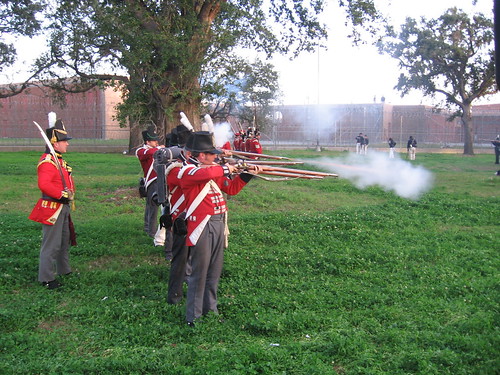
Free Men of Color re-enactors. Most of the Free Men of color did not get their promised bonus or land and were 'encouraged' to leave the city out of fear they might foster a slave revolt and act equal to whites.
The Attack Begins
As the British forces advanced the heavy fog lifted somewhat and dawn was breaking. They were viewed to be 600 yards from the American line. As the British advanced with drums,bugles and flags flying, the Americans let off a cheer, answered by the British, eager to come to grips with this annoying enemy. The light infantry companies of As the British advanced, artillery fire quickly tore huge gaps in the lines. In the narrow battlefield, the British had to march in column, not in line. One cannonball could kill and maim dozens. Throughout the battle, a New Orleans band played "Yankee Doodle" and other songs. The British guns were unable to silence the heavier American guns .When the British came within musket range the crack shops from Tennessee and Kentucky opened up with their long rifles, which were accurate to up to 300 yards with an experienced user and almost all of them were. This checked the advance and killed many .
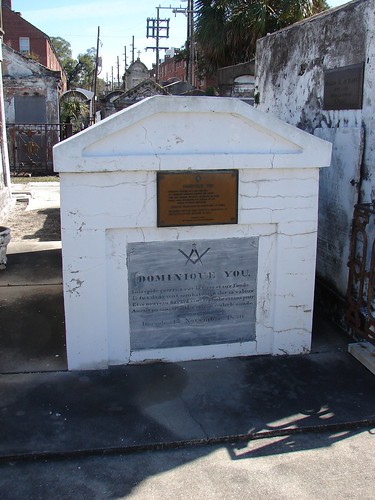
Tomb of Dominique You (1775-1830) Laffite's half brother who provided great service as an artillerist in the American line and highly praised by Jackson who was buried in New Orleans St. Louis Number 2 Cemetery
On the British left, General Keene divided his brigade. One force under Robert Rennie was sent against the American right line by the river. Colonel Rennie's troops took the forward redoubt on the extreme American left next to the river after hand to hand fighting. Rennie, two of his officers and three men managed to reach the rampart . "Hurrah, boy ! The day is ours !" he yelled before all six were killed by a volley from the New Orleans rifles. The rest of Rennie's column turned and ran, now coming under rifle fire and artillery from the rampart and across the river.
Gibbs now advanced obliquely toward the wooded swamp, with the Forty-fourth in front, followed by the Twenty-first and Fourth, terribly pelted by the storm that came from Batteries Nos. 6, 7, and 8, and vainly sought shelter behind a bulging projection of the swamp into the plain. These batteries poured round and grape shot incessantly into Gibbs’s line, making lanes through it, and producing some confusion. Those who survived to reach the ditch realized they had no means to cross it and scale the rampart. Where was the 44th ? Where was Mullens with the fascines and ladders ? Men who made it to the canal were mowed down by grapeshot and rifle fire waiting for the fascines and ladders . A few brave souls even swam across the canal and managed to climb the parapet . Gibbs turned around to see the 44th coming, led by Pakenham himself. He tried to inspire the men by reminding of their previous victories, but many were now running away or cowering in the face of the American fire. Pakenham was shot in the arm and his horse was killed. He mounted the horse of his aide. As more of his men retreated, Pakenham shouted " For shame ! Remember you are British soldiers!" He rode on and encountered Gibbs. Gibbs reported " I am sorry to report to you, that the troops no longer obey me." "Forty-third," Lt. Colonel Stovin shouted, " for God's sake save the day!" by which he meant the reserve column under Lambert . Seeing Gibbs' and Pakenham's situation, Keane ordered his Highlanders to support Gibbs.
Drawing of the battle from The battle of New Orleans, or Glory, love and loyalty; an historical and national drama, in five acts published 1816. The artist had to draw hills to give perspective, the area is as flat as a pancake
Keane's Oblique - The Death of Pakenham
Engraving of Pakenham's death done in 1816
Keane took a regiment of 900 Scottish Highlanders obliquely under Col. Dale quick marched across the field with bagpipes playing through withering American to aid Gibbs. At the sight of them, Gibbs' men halted their flight and reformed for a second attack on the rampart. Col. Dale was killed and the leaderless men stopped momentarily, 100 yards from the rampart, while grapeshot and bullets rained down on them and finally broke and fled. Keene rallied the remainder of Gibb's men and assaulted the American center and came to a point about 100 yards from the rampart, where they finally broke and ran. Keane was severely wounded and his attack on the right was failing. A diversionary attack by the black West Indian corps at the far left of the American line was also repulsed. Pakenham, seeing disarray his army was in told his aide, Major Tylden, to order up the reserve. The reserve army under Lambert was a mile away. Pakenham, seeing the highlander, used his left hand to raise his hat and yell "Hurrah! Brave Highlanders !" Then his was struck by grapeshot in the thigh, killing his horse, and sending him to the ground. As Pakenham fell was being raised by his faithful aid, Captain M‘Dougall, who had performed a similar service for General Ross when he fell, mortally wounded, near Baltimore a few months before, he was shot in the groin and paralyzed. The unconscious commander was removed from the battlefield to an old oak tree out of range of the American guns. A surgeon was summoned who pronounced the wound mortal. A few moments later, Pakenham died, he was 37 years old. Like many of the British soldiers the Napoleonic era, he been in battle for 18 to 20 years . What are often called the Pakenham Oaks, where he supposedly died, are a line of oaks planted on the de la Ronde's Plantation in the 1820's. Probably the Pakenham Oak was where the Chalmette Cemetery or the Kaiser Aluminum Refinery is now.
Unfortunately, Gibbs suffered an even more painful death. After Pakenham fell, Gibbs tried to rally what men he had left. He had gotten within 20 yards of the rampart when he was wounded and taken to the rear in agony and died the following day. Keane was also badly wounded in the neck and thigh and taken from the field. Now Wilkinson was the highest officer remaining in the field.
Wilkinson in charge, reached American Parapet
Command then fell to the highest ranking living officer who was Major Wilkinson. Major Wilkinson reformed his lines, and made a third assault. They were able to reach the entrenchments and attempted to scale them. Wilkinson made it to the very top of the parapet, before being shot dead. With this his men had enough, without officers the men retreated in chaos.
Major Wilkinson and Lt. Lavack and about 20 other men mounted the rampart by standing on each other's shoulders. Wilkinson was riddled with rifle and grapeshot. The Americans were amazed at his bravery and carried him behind the rampart. Major Smiley of the Kentucky militia said " bear up dear fellow. You are too brave to die." Wilkinson asked Smiley to tell his commander that he reached the rampart and "died like a soldier and a true Englishman." He died two hours later.
Lavack mounted the parapet unharmed and demanded the swords of two American officers there. They asked him to turn around. He was alone, the rest of the men having fled or thrown themselves into the ditch. He was made a prisoner.
The Attack on the West Bank
the Americans watched vigilantly for signs of the coming of the Thornton. Their vigilance was vain, for Thornton landed a mile below them under cover of three gun-boats under the command of Captain Roberts. Pushing rapidly up the road, Thornton encountered Morgan’s advance, when he divided his superior force, sending a part to attack Tessier, while with the remainder, and aided by Roberts’ carronades, he assailed Davis. Both commands were soon put to flight, and fell back in confusion on Morgan’s line. Tessier’s men could not gain the road, and many of them took refuge in the swamps, where they suffered much for several hours. When Thornton gained the open fields in front of Morgan’s line he extended his force, and with the sailors in column on the road, and the marines placed as a reserve, he advanced upon the American works under cover of a flight of rockets, and with the aid of Captain Roberts’ carronades. As the sailors rushed forward they were met by volleys of grape-shot from Philibert which made them recoil. Seeing this, Thornton dashed forward with the Eighty-fifth, and, handling the men with great skill and celerity, soon put the Kentuckians to flight, who ran in wild confusion, and could not be rallied. Following up this advantage, Thornton soon drove the Louisianans from the entrenchments, and gained possession of Morgan’s line after that general had spiked his cannon and cast them into the river. He next made for Patterson’s battery, three hundred yards in the rear. Its guns, which had been playing effectually on the British in front of Jackson’s lines, were now trained on the nearer foe on the river road. But Patterson, threatened by a flank movement, was compelled to give way; so he spiked his guns, and fled on board the Louisiana, while his sailors assisted in getting her into the stream, out of the reach of the enemy.
Lambert gave the order for his reserve to advance, but the bugler was shot in the arm, dropping the bugle. The reserve was used to cover the retreat of what was left of the English army in the field. Of attacking force nearly 300 were killed, 1262 injured and 484 taken prisoner. the Americans had 13 killed,39 wounded and 19 missing or captured. The battle had lasted less than 30 minutes .
Dealing with the Dead
The bodies of the British officers: Pakenham, Gibbs, Dale and Rennie were eviscerated and placed in casks of rum for the trip home. To keep the British for seeing the American position, the Americans brought the British dead to a spot close to Bienvenu's plantation on the very scaling-ladders left by the enemy when driven back, where they were buried in a mass grave. The officers were buried in the garden at their headquarters at Villere Plantation. Because of the soil conditions, they could not be buried deeply, and some started to come out of the ground in a ghastly sight to the American army which was occupying the area after the British left. Out of fear of cholera, Jackson sent the army back to New Orleans on Jan 21. Vistors reported a terrible smell for months later .
A lone bugle boy's Tale
One lone bugle boy managed to climb a tree within 200 yards of the American line. He continued to blow throughout the battle, with bullets and shot whizzing around him. He was captured after the battle unharmed and hailed as a hero by the Americans . After the battle was over, some 500 British soldiers who had pretended to be dead, rose up and surrendered .
Total Causalities for actions in the New Orleans Area in the War of 1812
Including all the battles in the New Orleans area, the British had about 3,700 causalities: 850 killed or who later died of wounds, 1200 wounded and 500 prisoners. The American causalities for all the actions in the New Orleans are were 333 with 55 killed, 185 wounded and 93 prisoners.
General Lambert in Charge - British Attack Ft. Phillip - Exchange of Prisoners - Retreat
Click for larger image .
General Lambert, now commander in chief, ordered an end to the main attack and recalled Thornton from the other side of the river. Cochrane still wanted another try to take New Orleans and decided to try an attack up the river with those ships of the fleet that could pass the shallow mouth of the Mississippi. On Jan 9th, the British sent 4 ships to attack Fort St. Phillip. After 10 days and firing a thousand rounds, the British gave up.
On January 18, there was an exchange of prisoners near the British mass grave. Lambert had been planning a retreat for weeks and reinforced the escape route back to Lake Borgne with a more solid road and redoubts. Still, with all those men marching on it, it quickly returned to a muddy mess, with men up to their chest in mud a points, some drowning in the quicksand like material. The British were harassed by Hind's dragoons, but Jackson did not launch a major attack, with most of his army being militia. The last of the British troops were back onboard the fleet by Jan 27. On Jan 19, the Americans discovered the British had slipped away in the night, leaving a ghost camp and some 80 severely wounded British soldiers, who were cared for by the Americans. Two weeks before the battle of Jan 8th, the Treaty of Ghent had been signed, word of which had not crossed the Atlantic. The British army attacked and captured Fort Bowyer at the mouth of Mobile Bay on February 12. The British army was making preparations to attack Mobile when news arrived of the peace treaty.
Victory Celebration
There was a grand victory celebrating in New Orleans on Jan 23. The center of the public square, in front of the Cathedral, where the equestrian statue of Jackson now stands, was erected a temporary triumphal arch, supported by six Corinthian columns, and festooned with flowers and evergreens. Beneath the arch stood two beautiful little girls, each upon a pedestal, and holding in her hand a civic crown of laurel. Near them stood two damsels, one personifying Liberty and the other Justice. From the arch to the church, arranged in two rows, stood beautiful girls, all dressed in white, and each covered with a blue gauze veil and bearing a silver star on her brow. These personified the several States and Territories of the Union. At the appointed time, General Jackson, accompanied by the officers of his staff, passed through the gate of the Grand Square fronting the river, amid the roar of artillery, and was conducted between lines of Plauché’s New Orleans battalion of Creoles (which extended from the gate to the church) to the raised floor of the arch. As he stepped upon it the two little girls leaned gently forward and placed the laurel crown upon his head. A Te Deum was held in St. Louis Cathedral.
The British attack was to be marked by delays and confusion in the execution of the plan. It seems obvious now that Pakenham should have withdrawn once he knew how stoutly the American line was defended. Perhaps try to land more of his force across the river and threaten New Orleans while keeping a force in front of Jackson. However, the river at New Orleans is over half a mile wide with a strong current, landing would be dangerous. Or take a page from the American playbook and attack in force in the middle of the night . However, in battles before , such as the siege of Badajoz in 1812, a frontal assault against a professional French army had succeeded , albeit it a great loss. There, 2,000 men were killed in two hours storming the city . After the brutal battle of Badajoz, the British troops went on an orgy of looting, killing and raping.
The American artillery was distributed on the lines in the following manner:
Map of the positions of the Americans at the main battle of New Orleans
On the soil of the road within the levee was Battery No. 1, commanded by Captain Humphreys, of the United States Artillery. It consisted of two brass twelve- pounders, and a six-inch howitzer, on field carriages; these pieces enfiladed the road towards that side where the enemy was posted, and their fire grazed the parapet of the flank of redoubt, towards the right. Battery No. 1, was seventy feet from the bank of the river. The two twelve- pounders were served by soldiers belonging to the regular artillery and the howitzer by dragoons of Major St. Geme's company.
Battery No. 2, which had a twenty-four-pounder, was commanded by Lieutenant Norris of the navy, and served by part of the crew of the late schooner Carolina; its distance from No. 1 was ninety yards. This battery was the most elevated above the soil.
Battery No. 3, commanded by Dominique You and Beluche, commanders of the privateers, had two twenty- four-pounders, which were served by French mariners; its distance from No. 2 was fifty yards.
Battery No. 4, commanded by Lieutenant Crawley, of the navy, and served by part of the crew of the Carolina, had a thirty-two-pounder; its distance from No. 3 was twenty yards.
Battery No. 5, commanded by Colonel Perry of the artillery, had two six-pounders; its distance from No. 4 was one hundred and ninety yards.
Battery No. 6, commanded by General Garrigues Flaujeac, and served by a detachment of the company of Francs under the immediate command of Lieutenant Bertel, had a brass twelve-pounder; its distance from No. 5 was thirty six yards.
Memorial for Major Spots, who died in 1833
Battery No. 7 had a long brass eighteen-pounder , and a six-pounder, commanded by Lieutenant Spotts and Chaveau, and served by gunners of the United States artillery; its distance from No. 6 was one hundred and ninety yards.
The 8th battery had a small brass cannon which rendered very little service on account of the ill condition of its carriage; it was commanded by a corporal of artillery, and served by militia-men of General Carroll's command; its distance from No. 7 was sixty yards.
Remains of the Rodriguez canal
An account of the Battle from The story of the Battle of New Orleans printed in 1915 by Arthur Clisby in 1915 by the Louisiana Historical Society on the 100th anniversary of the battle
On the early morning of the 8th, according to one American the fog was so dense you couldn't see more than forty yards in any direction .In a few minutes the head of the British column could be dimly seen. It appeared about two hundred feet long .
view the advancing British troops would have had of the American line
General Jackson, Carroll and Adair and Major Latour, Mr. Livingston and I got up on the parapet. In a minute or two the enemy began to move. Two rockets were fired, one toward us and one toward the river. 'That is their signal for advance, I believe,' General Jackson said. He then ordered all of us down off the parapet but stayed there himself and kept his long glass to his eye sweeping the enemy's line with it from end to end. In a moment he ordered Adair and Carroll to pass word along the line for the men to be ready, to count the enemy's files down as closely as they could, and each to look after his own file-man in their ranks, also, that they should not fire until told and then to aim above the cross-belt plates.
Then men were tense, but very cold. A buzz of low talk ran along the line for some minutes. The enemy's front line was now within five hundred yards, and the center of their formation was almost exactly opposite Carroll's left company or Adair's right one. Then — boom! went our first gun. As well as I can remember after so many years, it was fired from the long brass 12-pounder in Battery No. 6, which was commanded by Old General Fleaujeac, a French veteran who had served under Napoleon and came to Louisiana about 1802 or 1803. "Then all the guns opened. The British batteries, formed in the left rear of their storming column near the river, were still concealed from us by the fog, but they replied, directing their fire by the sound of our guns. It was a grand sight to see their flashes light up the fog — turning it into the hues of the rainbow
Still the enemy came on, but no sound from the rifle line; no fire but that of artillery on either side. Our Batteries Nos. 7 and 8 were on the rifle-line. Number 7 had an old Spanish 18-pounder and a 6-pounder. Number 8 had but one gun — a 6-pounder. The smoke from these hung in front of the works or drifted slowly toward the enemy with- out lifting much in the damp air. Adair noticed this and said it was worse than the fog ; that the smoke would spoil the aim of the riflemen when their turn came. Carroll agreed with him. Then General Jackson ordered these two batteries to cease firing, whereupon the smoke soon lifted and the head of the enemy's column appeared not more than three hundred to three hundred and fifty yards off and coming on at quickstep, with men in front carrying a few scaling-ladders.
Suddenly one rifle cracked a little to the left of where I stood. A mounted officer on the right and a little in front of the British head of column reeled in his saddle and fell from his horse headlong to the ground. What followed in an instant I cannot attempt to describe. The British had kept right on, apparently not minding the artillery fire much, though it was rapid and well-directed. They were used to it. But now, when every hunter's rifle from the right of Carroll's line to the edge of the swamp where Coffee stood, was searching for their vitals, the British soldiers stopped! That was something new, something they were not used to! "They couldn't stand it. In five minutes the whole front of their formation was shaken as if by an earthquake. Not one mounted officer could be seen. Either rider or horse, or both, in every case, was down — most of them dead or dying. I had been in battle where rifles were used up on the northwest frontier under Harrison. But, even so, I had never seen anything like this
In less than ten minutes the first line of the enemy's column had disappeared, exposing the second, which was about a hundred yards in its rear. You see, their formation was columns or brigade in battalion front and there were three battalions — or regiments — in the column, each formed four ranks deep. The plain was so level and their formation in line so dense that to a certain extent the front or leading battalion afforded some cover to the one following, and so on.
We were formed four deep, in open order, with plenty of room to move to and fro. As fast as one line fired, its men would step back to the rear and load. But the time the fourth line had fired the first one would be ready again, and so on.
When their leading battalion, which we now know to have been the Forty-fourth Regiment, was practically destroyed, the next one, which was the Seventh Regiment, had been already a good deal shaken by the halt and carnage in the first and by the headlong flight of the survivors around or through its ranks, and so the Seventh Regiment broke almost as soon as they got their full weight of our rifle- fire. This left exposed in turn their third regiment of the column which was the Fourth or King's Own Foot, and they, too, succumbed after a very brief experience. Almost, as incredible as it may seem, this whole column, numbering, I should say, 2,500 or 2,600 men, was literally melted down by our rifle-fire. To put it another way, this column had been to all intents destroyed and the work was done in less than twenty minutes from the first rifle-shot. No such execution by small arms was ever done before, and I don't believe it ever will be done again.
Some of our men got excited and talked about leaping over the breastwork to follow them. But these were sternly suppressed by all the officers and by the more sensible and prudent men in the ranks also. To have gone out in the open field then, with their second column and all their reserves unhurt, would have been the undoing of us!
The man who fired first was Morgan Ballard. The British officer was afterwards ascertained to be Brigade- Major John Anthony Whittaker, of the 21st Foot in General Gibb's Brigade.
Not long after the hour when the American general had been roused from his couch, General Pakenham, who had slept an hour or two at the Villere masion, also arose, and rode immediately to the bank of the river, where Thornton had just embarked his diminished force. He learned of the delay and difficulty that had there occurred and lingered long upon the spot listening for some sound that should indicate the whereabouts of the force sent across the river. But no sound was heard, as the swift Mississippi had carried the boats far down out of hearing. Surely Pakenham must have known that the vital part of his plan was, for that morning, frustrated. Surely he will hold back his troops from the assault until Thornton announced himself. The doomed man had no such thought. The story goes that he had been irritated by a taunt of Admiral Cochrane, who had said that, if the army could not take those mud-banks, defended by ragged militia, he would do it with two thousand sailors armed only with cutlasses and pistols and then the soldiers could bring up the baggage. Besides, Pakenham believed that nothing could resist the calm and determined onset of the troops he led. He had no thought of waiting for Thornton, unless, perhaps, till daylight
Map of British plan of attack at the start of the battle of New Orleans
Map of British attack at the battle of New Orleans. The troops of Gen. Samuel Gibb came under devastating fire. Gen. John Keane, ordered the 93rd Highlanders to march diagonally across the field to come to Gibb's aid. Of the 900 Highlanders, nearly 600 were killed. They fled from the murderous fire after they had gotten to about 100 yards from the rampart .
Map of last actions at the battle of New Orleans .Pakenham rode out to rally his troops and bring in the 44th and their fascines and ladders, and whose officer had disappeared. He tired to rally his troops by reminding them of their victories. He was hit many times and taken out of range of the American guns, where he died a few minutes later .Gibbs was also mortally wounded after reaching within 20 yards of the rampart, and died the next day. Keane was also severely wounded, so there was not a field commander left.
British troops nearest the river gained the top of the rampart before being repulsed
Area where Pakenham was mortally wounded
Monument to Generals Pakenham and Gibbs at St. Paul's Cathedral, London. Both were killed in the Battle of New Orleans.
The Battle of New Orleans lasted less than two hours. The British lost 291 killed, 1,267 wounded and 484 captured. The Americans lost 13 killed , 115 wounded and 74 captured.
Chalmette National Cemetery, est in 1865 with 15,000 graves behind the battlefield. One American who fought at the battle is buried here.
A report of a British officer of the battle, printed in the Yankee newspaper, Boston May 19, 1815 . Click image to see full article . List of Kentuckians and Louisianans in the battle
|
|
||
|
|
|
|||